 NeuroWellness
Baked Beetroot & Quinoa Patties
With grilled tomato relish and kefir cucumber
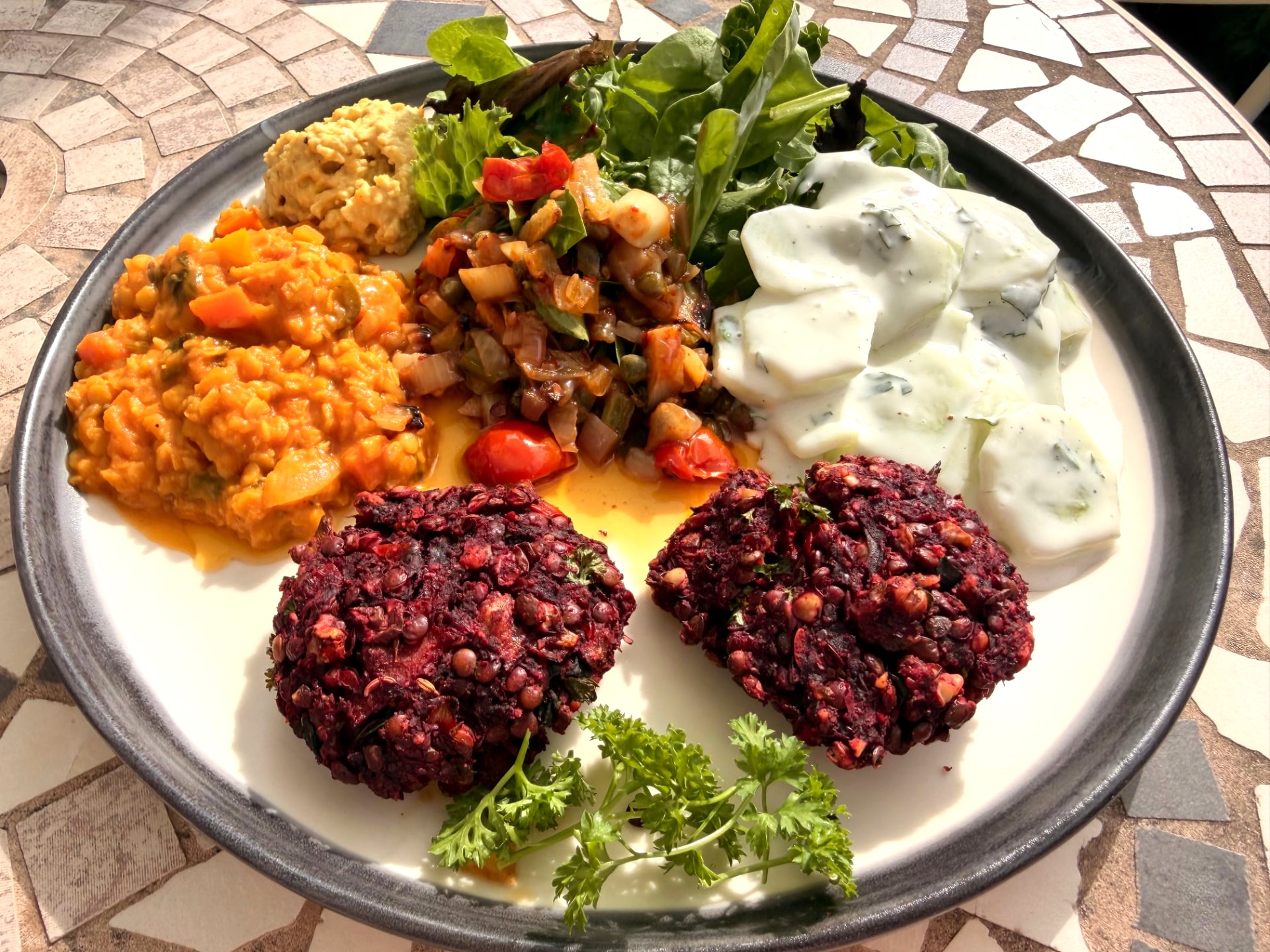
We do not eat buns in our house. Not the supermarket kind, anyway. They are difficult to digest, highly processed, and add almost nothing nutritionally to a plate that is already doing so much good work. So when people ask about my beetroot patties, the answer is always: there is no bun, and you will not miss it.
What you see on the plate instead is what food looks like when it is genuinely nourishing — colour, texture, fermented dairy, slow-cooked grains, roasted vegetables, and herbs picked fresh from the garden. Every component is there for a reason, and every one of them is made from scratch.
This is the full plate. The beetroot and quinoa patties are the centrepiece, but the grilled tomato relish and kefir cucumber are not afterthoughts — they are part of what makes this a complete, gut-happy meal.
On the plate above: baked beetroot & quinoa patties · grilled tomato relish · cucumber kefir · home-made hummus · red lentil dhal · fresh mixed leaves.
Baked Beetroot & Quinoa Patties
These patties are deeply satisfying in a way that does not leave you heavy. The beetroot brings earthiness and colour, the quinoa brings complete protein, the flaxseeds act as a natural binder, and the spices do something quietly remarkable — the whole thing smells extraordinary coming out of the oven.
Makes
6–8 patties
Prep
20 minutes
Bake
20–25 minutes
Oven
190°C / fan 170°C
Ingredients
- 2 medium beetroots, cooked and cooled
- 150g cooked quinoa, cooled completely (cook ahead and let it cool down)
- 2 tbsp ground flaxseeds
- 2 tbsp amaranth flour, plus a little extra if needed
- 1 shallot, very finely diced
- 2 cloves garlic, minced
- Small handful fresh dill, chopped
- Small handful fresh curly parsley, chopped
- 1 tsp ground turmeric
- 1 tsp ground cumin
- ½ tsp fennel seeds
- ½ tsp garam masala
- Himalayan salt and freshly ground black pepper
- Olive oil, for sautéing
Method
- 1
Prepare the beetroot
Grate the cooked beetroots and set aside. Press them gently in a clean cloth or kitchen paper to remove excess moisture — this is important for the patties to hold their shape.
- 2
Sauté the shallot and spices
In a small pan, warm a little olive oil over a medium heat. Sauté the shallot for 3–4 minutes until soft and translucent. Add the garlic, fennel seeds, turmeric, cumin and garam masala, and cook for another minute until fragrant. Remove from the heat and leave to cool completely.
- 3
Combine
In a large bowl, combine the grated beetroot, cooled quinoa, cooled spiced shallot mixture, ground flaxseeds, amaranth flour, dill and parsley. Season generously with salt and pepper. Mix well until everything is evenly combined.
- 4
Shape
With slightly damp hands, shape the mixture into patties — approximately 2cm thick. If the mixture feels too wet, add a little more amaranth flour. Place on a lined baking tray.
- 5
Bake
Bake at 190°C (fan 170°C) for 20–25 minutes, turning once halfway through, until the outside is set and beginning to firm. They will continue to firm up slightly as they cool.
Some patties go straight to the table. The rest go into the freezer — already shaped, between sheets of baking parchment. A ready meal that is actually good for you.
Freezer tip: freeze uncooked patties on a lined tray first, then transfer to a container. Bake from frozen at 190°C for 30–35 minutes.
Why quinoa belongs on your plate
Quinoa is one of the few plant foods that is a complete protein — meaning it contains all nine essential amino acids your body cannot produce itself. For women in particular, this matters.
It is also high in fibre, which feeds the gut microbiome and supports the production of short-chain fatty acids — a direct input into gut-brain health. Magnesium, abundant in quinoa, plays a role in nervous system regulation, sleep quality and muscle recovery. And unlike most grains, quinoa has a low glycaemic index, so it supports steady energy rather than the spike-and-crash pattern.
Beyond the nutrition, it is endlessly versatile. It works warm, cold, in a patty, in a bowl, with fruit, with vegetables, with fermented dairy. Once you have a batch cooked and chilled in the fridge, it goes into almost anything.
Other quinoa recipes from the Kitchen — Watermelon, Quinoa & Seed Salad and the Gut-Brain Bowl.
And the dish I make more than any other: The Gut-Brain Bowl
Grilled Tomato & Pepper Relish
No supermarket sauces. This relish takes about fifteen minutes and tastes like something you would find in a very good restaurant — intensely flavoured, slightly smoky, with a little acidity from the vinegar and depth from the capers. It is good with almost everything.
Ingredients
- 3 small shallots, finely diced
- 15–20 cherry tomatoes, quartered
- 1 red pepper, finely diced
- Pinch of chilli flakes
- Good olive oil
- 1 tbsp capers
- Dash of white wine vinegar
- Dash of balsamic vinegar
- Small handful fresh curly parsley
- Himalayan salt and freshly ground black pepper
Method
- 1
Dress the vegetables
Combine the shallots, cherry tomatoes and red pepper in a bowl. Drizzle with olive oil, add a pinch of chilli flakes, and massage everything together with your hands until the vegetables are well coated and beginning to release their juices.
- 2
Grill
Spread onto a baking tray and place under a hot grill. Cook for 8–10 minutes, turning once, until the tomatoes are blistered and the pepper is beginning to char at the edges.
- 3
Finish
Transfer to a bowl, making sure to scrape up all the juices from the tray — this is where the flavour is. Add the capers, a dash of white wine vinegar, a dash of balsamic, and a little more olive oil. Season well. Stir through the parsley.
- 4
Serve warm
Leave to cool slightly before serving alongside the patties. The relish should be warm but not hot when it hits the plate.
The smell of the pepper under the grill is reason enough to make this.
Cucumber & Kefir Yoghurt with Fresh Mint
Cool, tangy, and quietly medicinal. Kefir yoghurt is one of the most probiotic-rich foods you can include in a meal — it is fermented, which means it actively supports the gut microbiome in a way that regular yoghurt does not quite match. The cucumber brings hydration and freshness; the fresh mint from the garden makes it taste like summer. If you want to understand why I use kefir so often, read What Is Kefir — And Why Is It So Much More Than Yoghurt?
Read more about why kefir is so much more than yoghurt.
Ingredients
- ½ cucumber, sliced or diced
- 4–5 tbsp kefir yoghurt
- Small handful fresh mint leaves, torn or finely chopped
- Pinch of Himalayan salt
Method
Combine everything in a bowl. Mix gently. Taste and adjust the salt. That is it — this is the simplest thing on the plate, and one of the most important ones for your gut.
The full plate
The patties, the relish and the kefir cucumber are a complete meal on their own. On the plate in the photograph, there is also a red lentil dhal with roasted vegetables, home-made hummus, and fresh mixed leaves. Each of these is worth its own recipe — and they are coming.
The dhal is a slow, warming dish that will be perfect as the days begin to shorten in September. The hummus — both a turmeric version and a beetroot version — will follow shortly after. Both have been made many times in this kitchen and both are worth the wait.
Coming soon to the Kitchen: Turmeric Hummus · Beetroot Hummus · Red Lentil Dhal with Roasted Vegetables.
The content on this page is for informational purposes only and is not intended as medical advice. If you have specific dietary requirements, digestive concerns or health conditions, please speak with your GP or a qualified healthcare professional. I work with clients on nutrition, gut and brain health, sleep hygiene and nervous system regulation — if you would like to discuss your own health and wellbeing, you are welcome to reach out.