 NeuroWellness
What restorative yoga actually is
Restorative yoga is not a gentle version of a vinyasa class. It is not slow stretching. And it is not Yin yoga — though the two are often confused, and that confusion is worth addressing directly.
Yin yoga targets the connective tissue — fascia, ligaments, tendons — through sustained holds that create gentle stress on those structures. It is a valuable practice in its own right.
Restorative yoga does something different. It asks the body to do nothing at all. The guiding principle is simple: support creates release. When the body is fully held — by the floor, by props, by the intelligence of the pose — the nervous system recognises that there is nothing to brace against. And it lets go.
This is not passive. It is one of the most active things a nervous system can do.
🌿 Want to understand restorative yoga more deeply?
I have also recorded a longer conversation — Restorative Yoga & Your Vagus Nerve: Why Deep Rest Is Not the Same as Sleep.
Watch the 14-minute video →Where it comes from
Restorative yoga has its roots in the teachings of B.K.S. Iyengar — widely regarded as one of the most influential yoga teachers of the twentieth century. Iyengar observed early in his career that when students strain in a pose, pain and injury follow. He began experimenting with props — blankets, bolsters, blocks, straps — until the student could practise without effort or strain. He also discovered that these supported poses had a profound effect on recovery from illness and injury.
His student Judith Hanson Lasater took those principles and built what we now recognise as restorative yoga, establishing it as a distinct practice and writing the foundational text Relax and Renew. Her daughter Lizzie Lasater continues to teach and develop the lineage today.
I trained with Anna Ashby in London, completing both Level 1 and Level 2 specialist certifications — over 55 hours of dedicated restorative training rooted in the Iyengar tradition. That lineage is present in how I teach every session.
Why props are not optional
When people imagine a restorative yoga class, they sometimes picture a bolster under the knees and a blanket for warmth. That is a starting point — not the practice.
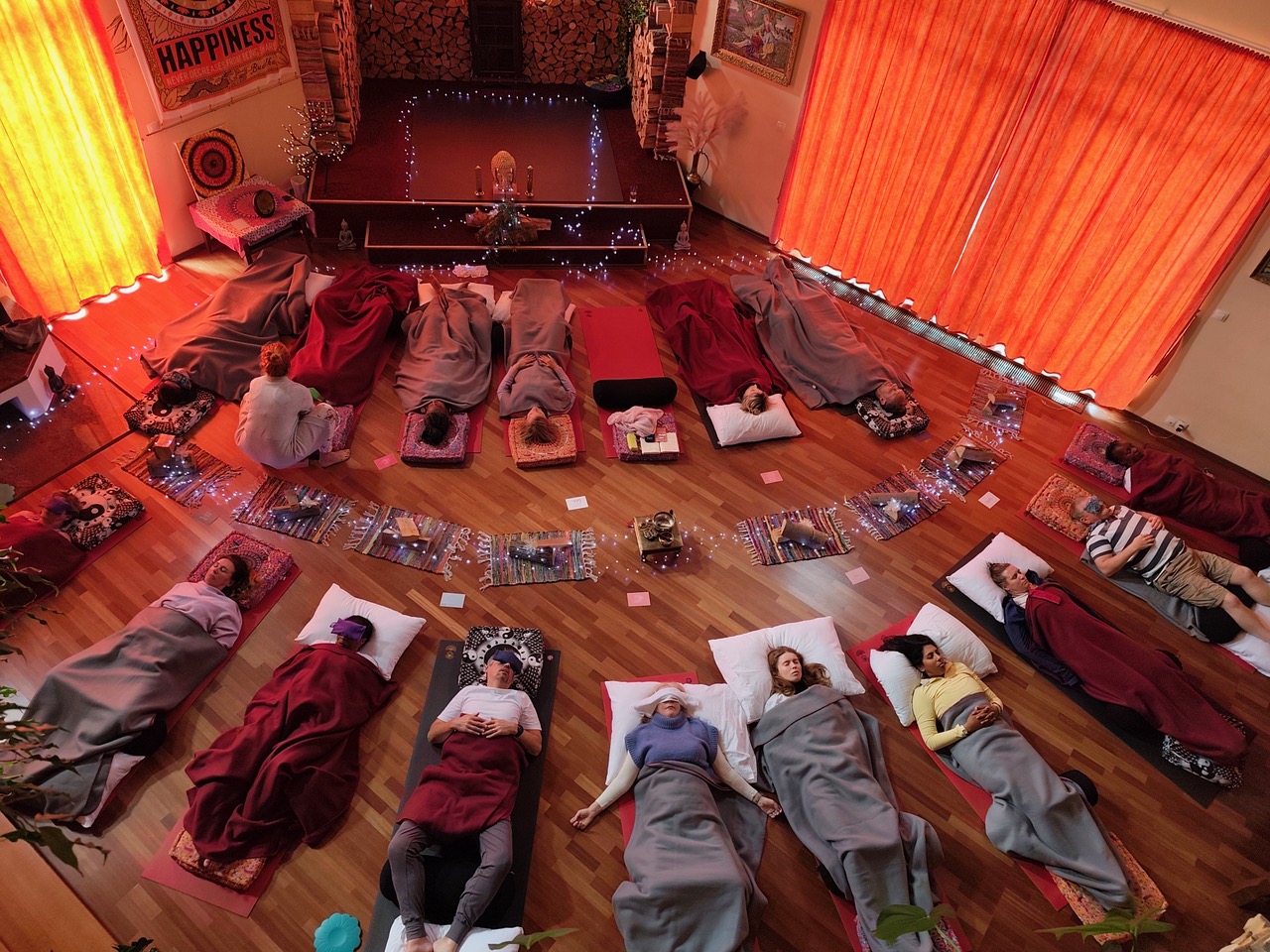
Restorative yoga uses props — blankets, bolsters, blocks, straps, eye pillows, sandbags — because every body is different. Every person carries tension, habitual holding, and trauma in different places. A pose that allows complete release in one body may create subtle effort in another. Props are how we close that gap.
The area I pay particular attention to — and which many teachers overlook — is the head and neck. Scroll through restorative yoga images online and you will rarely see the head and neck properly supported. This matters more than most people realise.
The neck and skull are rich in proprioceptors — sensory nerves that detect position, pressure, and movement. The position of the chin in particular has a direct influence on the parasympathetic nervous system. A supported, gently lowered chin — rather than a head tipping back or lifting — activates the parasympathetic response, shifting the nervous system away from the stress state and into genuine rest.
This is not about aesthetics or alignment. It is physiology. When the head and neck are properly held, the body stops bracing. When the body stops bracing, the practice can truly begin.
Every session I teach begins with making sure your unique body is fully supported — starting with the head and neck, and working outward from there.
How restorative yoga connects to your nervous system
The nervous system has two primary modes: sympathetic (activated, responsive, vigilant) and parasympathetic (resting, restoring, digesting). Modern life loads the sympathetic system heavily — and for many women, particularly those navigating perimenopause, chronic stress, or hormonal disruption, the parasympathetic system rarely gets the space it needs to fully activate.
Held, fully supported poses stimulate the vagus nerve — the longest cranial nerve in the body, running from the brainstem through the heart, lungs, and gut, and the primary pathway of the parasympathetic nervous system. As vagal tone improves, so does the body's ability to recover, digest, regulate mood, and sleep. The breathwork and visualisations woven through a restorative session deepen this effect further.
This is sometimes called deep rest — and it is distinct from sleep. During sleep, the nervous system remains partially active, processing and dreaming. In deep rest, with the body fully supported and the mind gently anchored, the nervous and muscular systems can slow in a way that allows the body's vital systems to restore more completely. Heart rate and blood pressure lower. The immune and endocrine systems are gently supported. The body does what it was designed to do — when we finally give it the conditions to do it.
What happens in a session
Each session is built around your body, your nervous system, and what you are carrying that day. I use a range of props to create complete support — with particular care for the head and neck — and work with breathwork, visualisation, and vagus nerve techniques throughout.
Supported poses — Backbends, forward folds, twists, and inversions — each modified with props to allow full release without effort or strain. The body is held, not stretched. The pose does the work.
Breathwork — Slow, conscious breathing directly stimulates the vagus nerve and deepens the parasympathetic response. We work with specific breath ratios and rhythms depending on what the nervous system needs.
Visualisation — Guided imagery supports the nervous system in releasing held tension and moving into genuine rest. For many people, this is the element that reaches places the physical support alone cannot.
Vagus nerve techniques — Head and neck positioning, sound, breath, and specific somatic approaches that activate the parasympathetic pathway directly — not as an add-on, but woven through the session.
Props guidance — You will learn how to use props effectively for your own body. The practice does not need to stay in the studio — I want you to be able to recreate this support at home.
Why I teach this way
I hold Level 1 and Level 2 certifications in Restorative Yoga, trained with Anna Ashby in London — over 55 hours of specialist training in the restorative method and its Iyengar lineage. I also bring over 500 hours of teaching each year across 1:1 client sessions, group work, and retreats, much of which goes deep into restorative practice, nervous system regulation, and vagus nerve stimulation.
In that teaching experience, I have come to understand something clearly: the precision of how a body is held in a pose determines whether the practice works. A bolster in the wrong position creates effort. The right support creates surrender. Much of what I do in a session is reading that difference — and adjusting until release is possible.
I chose restorative yoga specifically because of what it does for the nervous system. In a world that asks women to perform, produce, and keep moving, the ability to deeply rest is not indulgent. For many women I work with, it is the most challenging thing they do — and the most necessary.
Who this is for
This practice is for you if:
You are exhausted but cannot seem to rest — no matter how much sleep you get.
You carry chronic tension, particularly in the neck, jaw, shoulders, or hips.
You are navigating perimenopause, hormonal disruption, or a sustained period of stress.
You have tried yoga before but found it too fast, too demanding, or simply not quite right.
You want a practice that genuinely supports your nervous system — not just your flexibility.
You do not need yoga experience. You do not need to be flexible. You need a body and a willingness to be still.
How we work together
I offer restorative yoga in small group sessions and in 1:1 personalised sessions, where we go deeper — into nervous system regulation, vagus nerve work, visualisation, and the specific prop combinations that work for your body.
Restorative practice is also one of the three core pillars of The 12-Week Return — my personalised programme built around your nervous system, your hormones, and your life.
Group sessions — Wednesdays: Evening Harmony, 65 minutes, at Brickhill Community Centre, Bedford
1:1 personalised sessions — online & in-person
The 12-Week Return — hybrid, online & in-person
Ready to feel like yourself again?
Join me for a 90-minute Restorative Embodiment & Resilience immersion at Brickhill Community Centre, Bedford. A held, deeply restful practice for your nervous system.
Book your place→Rather talk it through first? Book a free 30-minute call to see whether restorative yoga is the right starting point for you.
Book your free call→Explore the 12-Week Return→julia@neurowellness.one